The situation
Project Synergy has worked in prototype and pre-production operations for the automotive industry for 20 years. It works with car manufacturers and has supported more than 200 prototype build events. As the industry moved to faster development cycles, its traditional systems struggled with speed, scale and security.
The problems were these:
- The legacy infrastructure did not scale, so deployments got stuck at peak load.
- Servers were provisioned by hand, without infrastructure as code, which led to configuration drift and downtime.
- Container images were barely scanned and workloads were not isolated from each other.
- Teams had little visibility into system health, so problems were found and fixed slowly.
- There were no solid CI/CD pipelines, and manual steps caused mistakes.
- External partners and internal business units needed to be onboarded without competing for resources.
What we built
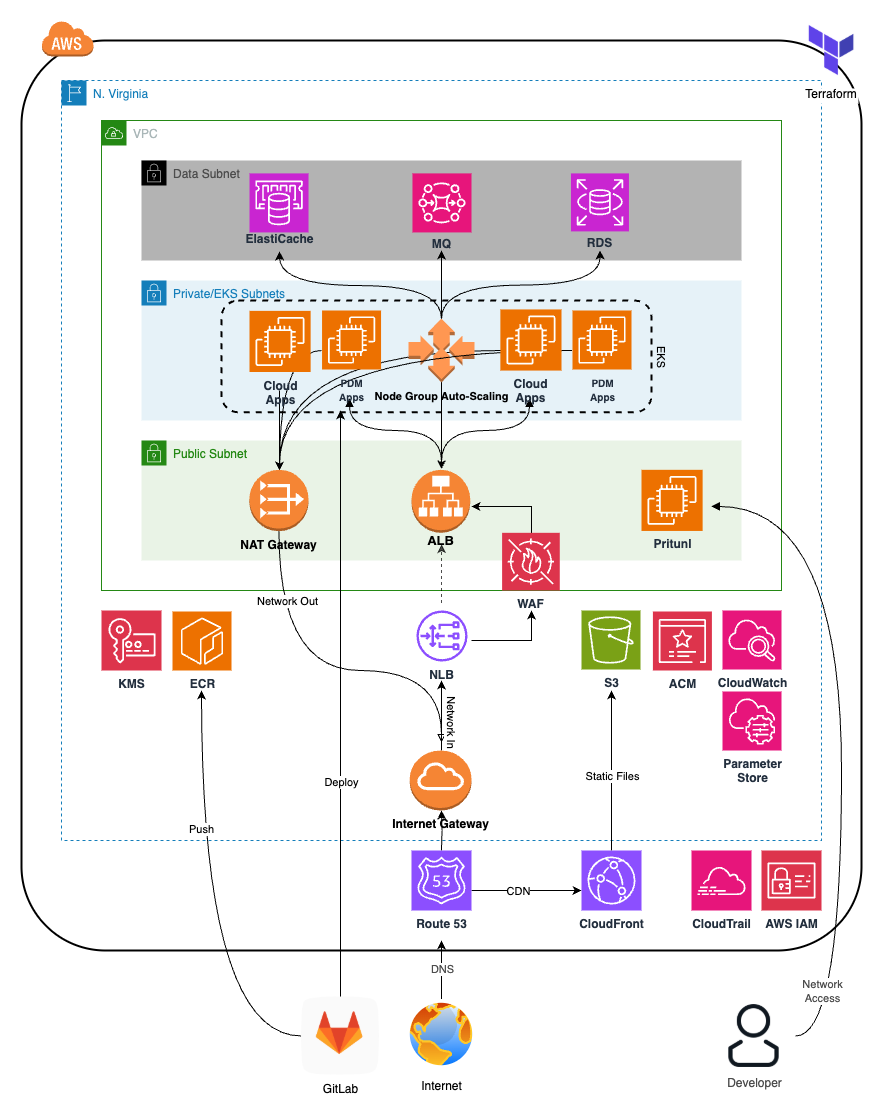
Project Synergy worked with AWS and Magicorn on a platform based on Amazon Elastic Kubernetes Service (EKS).
- Two EKS clusters in the us-east-1 region, one for production and one for non-production.
- Terraform for all infrastructure, so every environment is consistent, versioned and repeatable.
- GitLab CI/CD pipelines for build, test and deployment, with canary and blue/green deployments.
- Kubernetes namespaces with RBAC, network policies and resource quotas, so that several tenants can share the clusters safely.
- Amazon Inspector and ECR image scanning, so only images without known vulnerabilities are deployed.
- TLS termination and certificate management through the AWS ALB Ingress Controller and AWS Certificate Manager.
- Monitoring with Amazon CloudWatch, Prometheus, Grafana, Kubernetes Lens and OpenTelemetry.
- IAM Roles for Service Accounts (IRSA), so pods only get the AWS permissions they need.
Amazon RDS holds the persistent data, AWS Fargate runs some workloads without servers, and Helm keeps deployments consistent.
Results
Deployments went from over two hours to under ten minutes, through GitLab CI/CD automation. Compute costs fell by up to 30%, because development environments run on spot instances and scalable workloads on Fargate. Mean time to detect and mean time to resolve problems both improved by more than 60% with the new monitoring stack.
Namespaces, quotas and network policies make it possible to onboard external partners without interference between tenants. The platform scales horizontally, new clusters can be provisioned quickly, and Terraform modules govern multiple accounts. Developers can test, deploy and roll back features themselves.